Question 1 of 20
In a DNA nucleotide, which component carries the genetic code through its specific sequence?
APhosphate group
BNitrogenous base
CDeoxyribose sugar
DHydrogen bond
Explanation
The nitrogenous base (adenine, thymine, guanine, or cytosine) is the part of a DNA nucleotide that varies — its sequence along the strand IS the genetic code. The phosphate and deoxyribose sugar are identical in every nucleotide and form the structural 'backbone' of the DNA strand; they don't store information. Hydrogen bonds hold the two strands together at the bases but are not part of a single nucleotide.
Question 2 of 20
In a Punnett square cross Bb × Bb, what fraction of offspring are expected to be homozygous recessive (bb)?
A75%
B0%
C25%
D50%
Explanation
📌 BB:Bb:bb = 1:2:1
bb = 1/4 = 25%
bb = 1/4 = 25%
Question 3 of 20
Which graph correctly shows exponential growth?
AB
BNeither
CBoth
DA
Explanation
📌 Exponential growth = J-shaped curve (slow start, rapid increase)
Linear growth = straight line (constant rate)
Graph A shows exponential growth.
Linear growth = straight line (constant rate)
Graph A shows exponential growth.
Question 4 of 20
A student designed an experiment to test how light affects plant growth. Identify the components of this experiment. 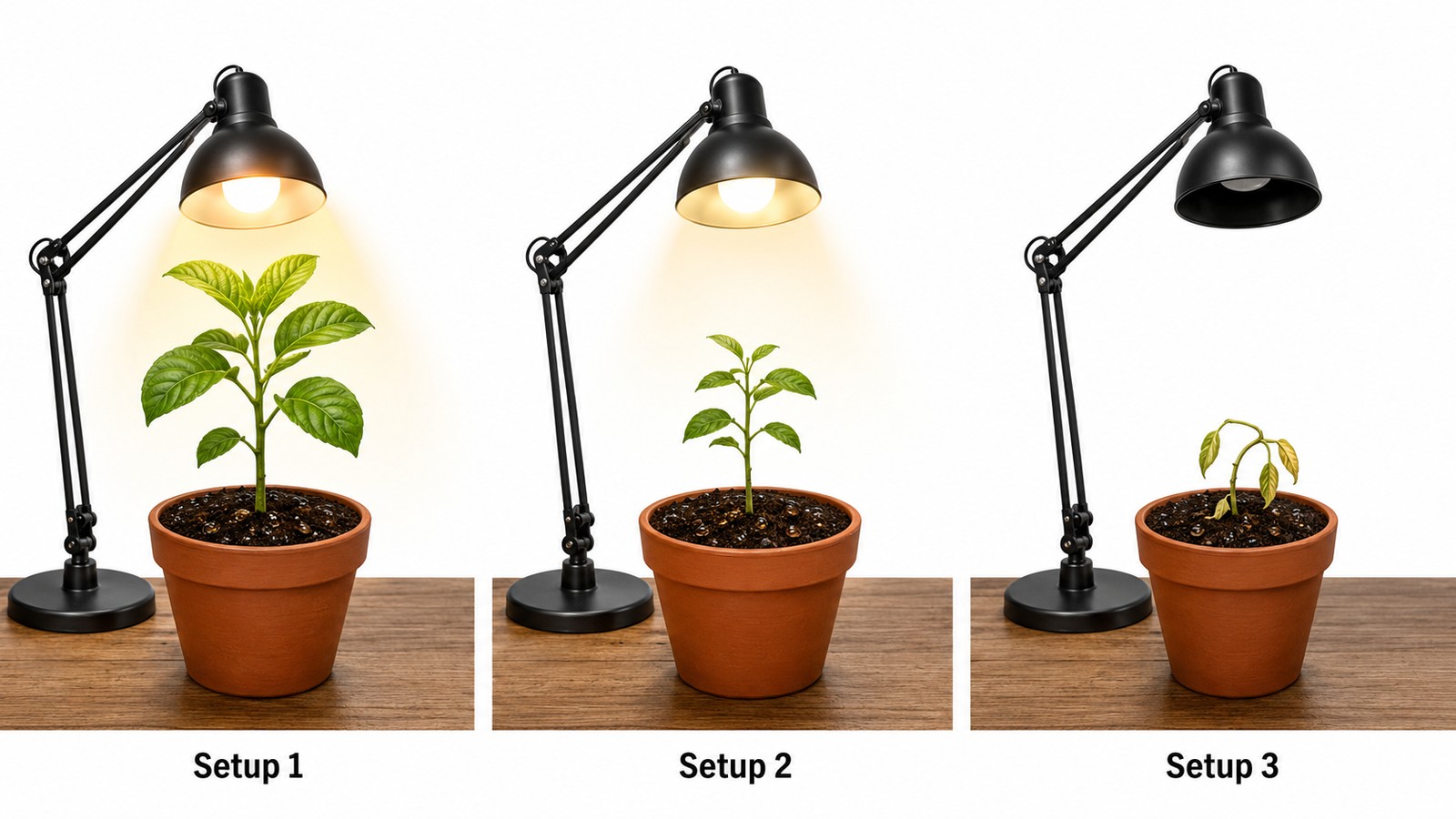
AIndependent: temperature; Dependent: light
BIndependent: water; Dependent: soil
CIndependent: light; Dependent: plant height
DIndependent: plant height; Dependent: light
Explanation
📌 Independent variable = what you change (light)
Dependent variable = what you measure (plant height)
Control group = no light (to compare against)
Constants = same soil, water, temperature, pot size
Dependent variable = what you measure (plant height)
Control group = no light (to compare against)
Constants = same soil, water, temperature, pot size
Question 5 of 20
Which molecule carries energy from glucose breakdown to the electron transport chain?
AATP
BNADH
CCO2
DH2O
Explanation
📌 NADH and FADH2 are electron carriers. They transport high-energy electrons from glycolysis and Krebs cycle to the ETC.
Question 6 of 20
The graph shows the change in a moth population over time. Dark moths increased after industrial pollution darkened tree bark. This is an example of:
AArtificial selection
BSpontaneous generation
CNatural selection
DGenetic engineering
Explanation
📌 This is the classic peppered moth example of natural selection.
Before pollution: light bark → light moths camouflaged → survived
After pollution: dark bark → dark moths camouflaged → survived
The environment selected for the trait that provided camouflage.
Before pollution: light bark → light moths camouflaged → survived
After pollution: dark bark → dark moths camouflaged → survived
The environment selected for the trait that provided camouflage.
Question 7 of 20
Which pair of processes drives the most direct exchange of CO₂ between living organisms and the atmosphere?
ATranspiration (releases CO₂) and condensation (absorbs CO₂)
BPhotosynthesis (releases CO₂) and cellular respiration (absorbs CO₂)
CNitrogen fixation (absorbs CO₂) and decomposition (releases O₂)
DPhotosynthesis (absorbs CO₂) and cellular respiration (releases CO₂)
Explanation
Photosynthesis consumes atmospheric CO₂ to build glucose (CO₂ → sugar), while cellular respiration breaks glucose back down to CO₂ and water. Together they form the short-term carbon cycle between the biosphere and atmosphere. Distractor B reverses the direction. Transpiration moves water vapor, not CO₂. Nitrogen fixation moves nitrogen, not carbon.
Question 8 of 20
Why does the left ventricle have a thicker muscular wall than the right ventricle?
AIt receives more deoxygenated blood from the body
BIt is in direct contact with the lungs
CIt must pump blood at higher pressure to reach the entire body
DIt contains valves that the right ventricle lacks
Explanation
The left ventricle pumps oxygenated blood through the *systemic circuit* — every tissue in the body — which requires high pressure. The right ventricle only needs to push blood a short distance to the lungs (pulmonary circuit), so its wall is thinner. Distractors: the left ventricle pumps *oxygenated* blood, not deoxygenated. Both ventricles have valves (AV and semilunar). The right ventricle, not the left, is closer to the lungs.
Question 9 of 20
Which organelle is labeled X in the cell diagram below? 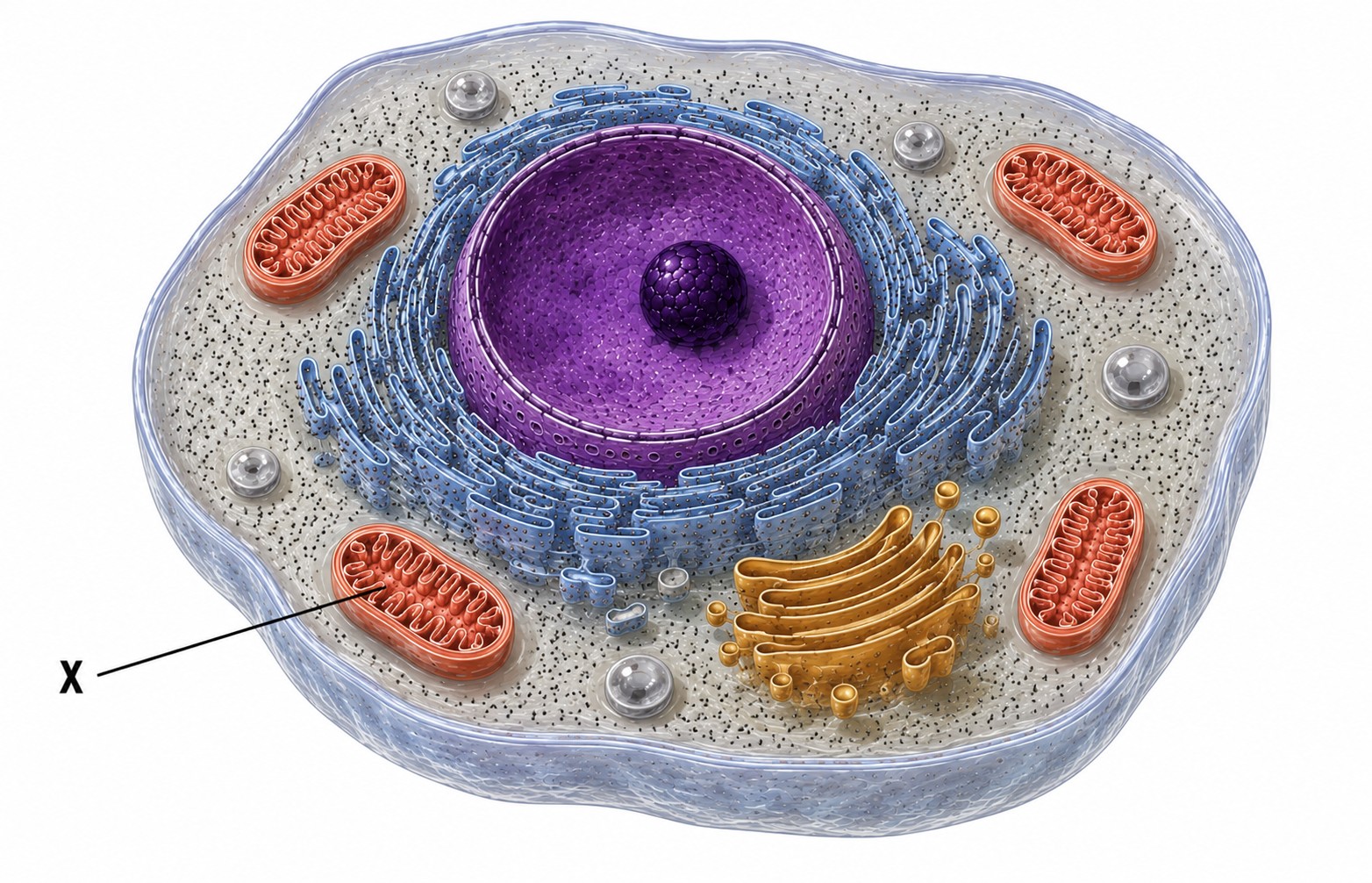
AEndoplasmic reticulum
BMitochondria
CNucleus
DGolgi apparatus
Explanation
📌 Organelle X has the bean-shaped structure with inner folds (cristae) → Mitochondria
Mitochondria = powerhouse of the cell = produces ATP through cellular respiration
C₆H₁₂O₆ + 6O₂ → 6CO₂ + 6H₂O + ATP
Mitochondria = powerhouse of the cell = produces ATP through cellular respiration
C₆H₁₂O₆ + 6O₂ → 6CO₂ + 6H₂O + ATP
Question 10 of 20
Which class of biomolecule is built from nucleotide monomers?
AProteins
BCarbohydrates
CLipids
DNucleic acids (DNA and RNA)
Explanation
Nucleic acids (DNA, RNA) are polymers of nucleotide monomers — each nucleotide is a phosphate + sugar + nitrogenous base. Distractors: Proteins are polymers of *amino acids*. Carbohydrates are polymers of *monosaccharides* (e.g., glucose). Lipids are not true polymers — they assemble from fatty acids and glycerol but don't repeat a single monomer.
Question 11 of 20
A theory in science is:
Aa well-supported explanation based on extensive evidence
Ban untested guess
Ca proven fact that can never change
Dthe same as a hypothesis
Explanation
📌 A scientific theory is well-tested, widely accepted, and explains a broad range of observations.
It is NOT just a guess — that's a hypothesis.
It is NOT just a guess — that's a hypothesis.
Question 12 of 20
The Hardy-Weinberg principle states that allele frequencies remain constant when:
Athere is no evolution occurring
Bmutations are common
Cnatural selection is strong
Dthe population is very small
Explanation
📌 Conditions: no mutation, no migration, random mating, large population, no natural selection.
Any violation → evolution occurs.
Any violation → evolution occurs.
Question 13 of 20
Epigenetics studies how:
Agene expression changes without altering DNA sequence
Borganisms evolve
Ccells divide
DDNA sequence changes
Explanation
📌 Epigenetics = changes in gene expression WITHOUT changing DNA sequence.
Mechanisms: DNA methylation, histone modification.
Affected by environment, diet, stress.
Mechanisms: DNA methylation, histone modification.
Affected by environment, diet, stress.
Question 14 of 20
In the food web below, what would happen if all the frogs were removed? 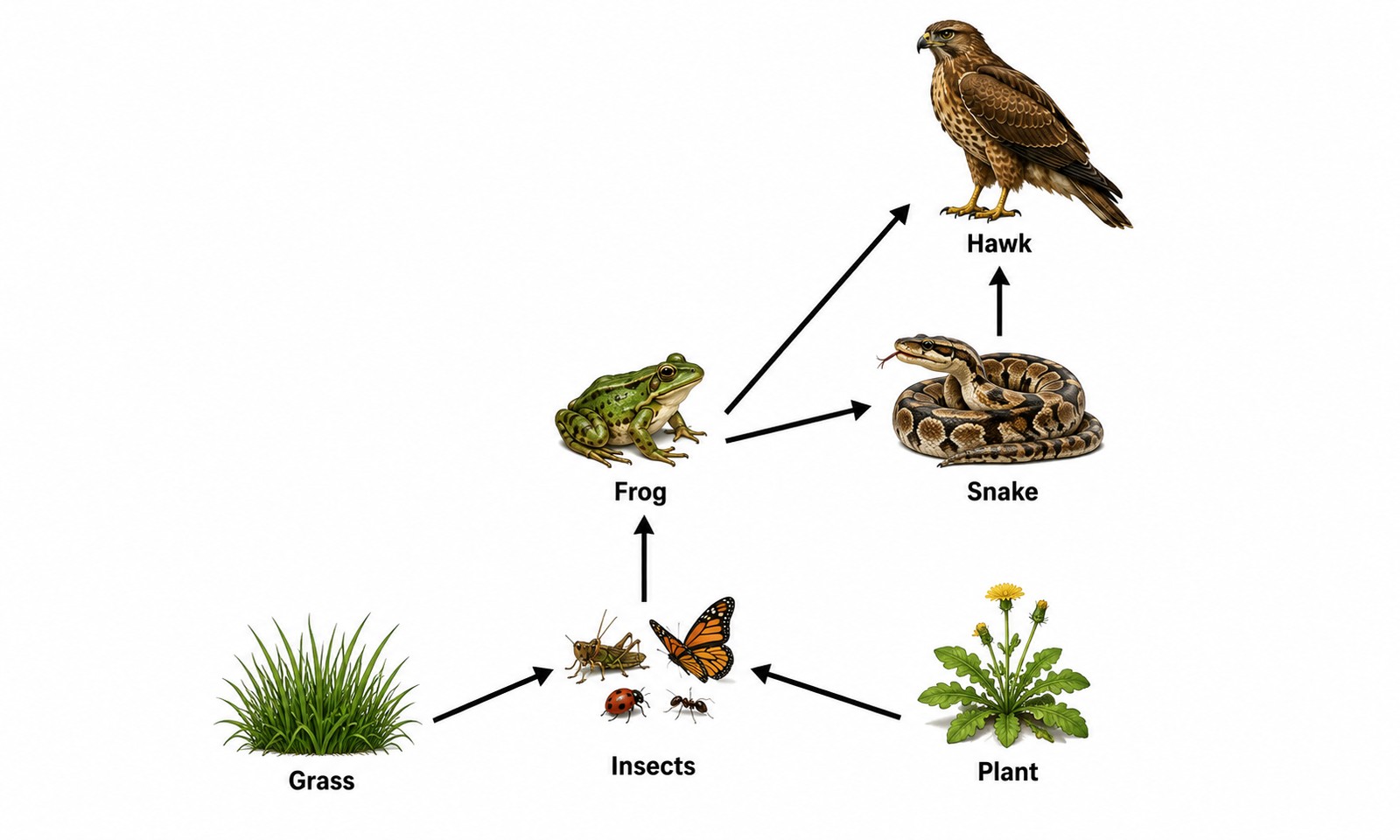
ANothing changes
BAll organisms die
CSnake population increases
DInsect population increases and snake population decreases
Explanation
📌 If frogs are removed:
• Insects (grasshoppers) they ate would INCREASE (no predator)
• Snakes that ate frogs would DECREASE (less food)
• This demonstrates how removing one species affects the entire food web.
• Insects (grasshoppers) they ate would INCREASE (no predator)
• Snakes that ate frogs would DECREASE (less food)
• This demonstrates how removing one species affects the entire food web.
Question 15 of 20
All three domains of life (Bacteria, Archaea, and Eukarya) share which structural feature?
AMulticellular organization
BChloroplasts for photosynthesis
CRibosomes for protein synthesis
DA membrane-bound nucleus
Explanation
All cellular life — Bacteria, Archaea, and Eukarya — uses ribosomes to build proteins. Distractors: a membrane-bound nucleus is found only in Eukarya (Bacteria and Archaea are prokaryotic). Multicellularity appears only in some Eukarya — most life is unicellular. Chloroplasts are organelles found only in plants and algae (a subset of Eukarya).
Question 16 of 20
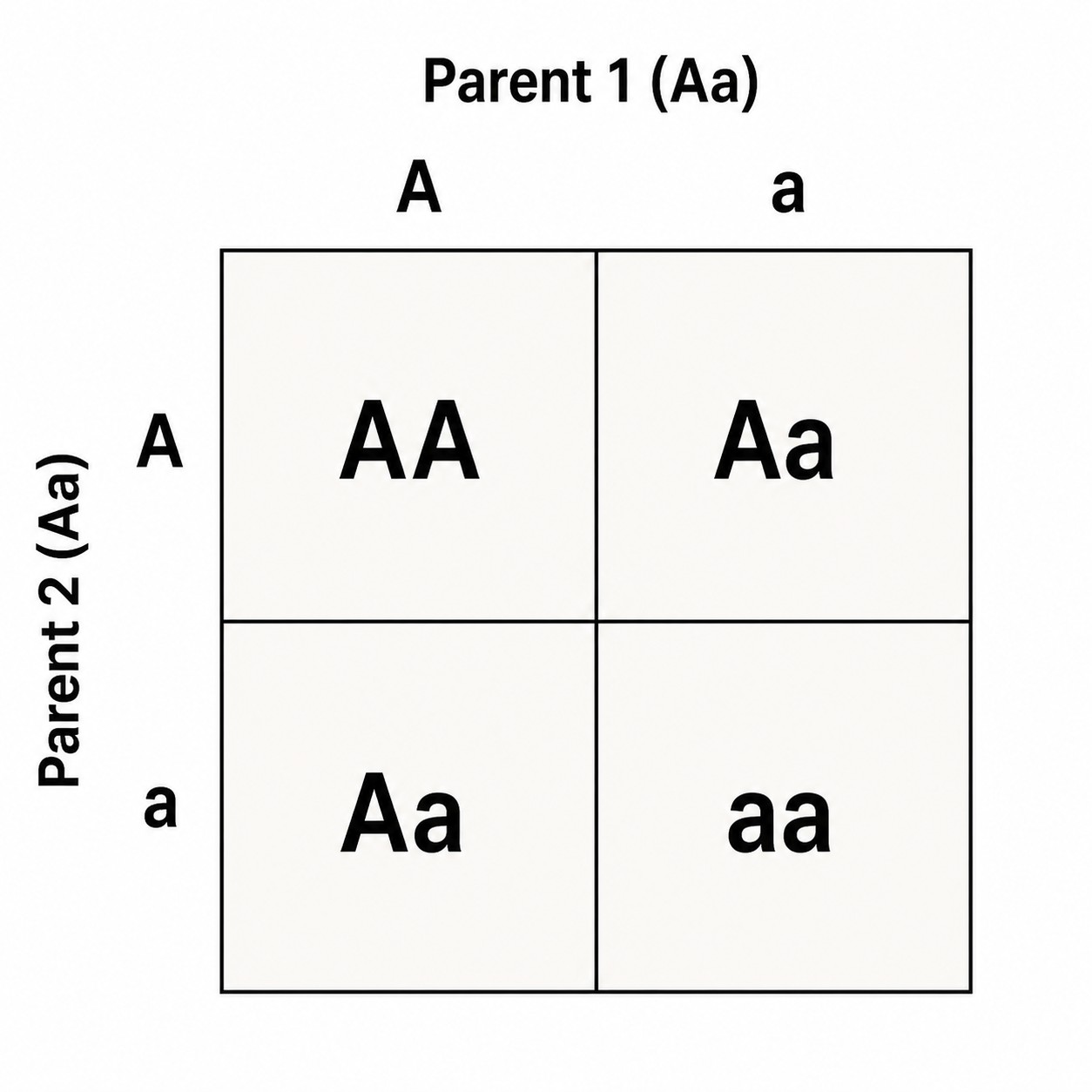
Use the Punnett square to determine the probability of offspring with the homozygous recessive (aa) genotype.
A3/4 (75%)
B0
C1/2 (50%)
D1/4 (25%)
Explanation
Aa × Aa cross: AA, Aa, Aa, aa. Only one box (aa) shows the homozygous recessive: 1/4 = 25%.
Question 17 of 20
Alternative splicing allows:
ADNA to be repaired
Bchromosomes to separate
Cone gene to code for multiple proteins
Dmutations to be prevented
Explanation
📌 One gene → multiple proteins by including/excluding different exons. Increases protein diversity without needing more genes.
Question 18 of 20
Lipids store roughly twice as much energy per gram as carbohydrates. Which property of lipid molecules best explains this?
AThey contain more nitrogen atoms than carbohydrates
BThey form longer polymer chains than carbohydrates
CThey are insoluble in water, so they take up less space when stored
DLong hydrocarbon chains contain many C–H bonds that can be oxidized to release energy
Explanation
Lipid fatty-acid tails are long chains of carbon–hydrogen bonds. Oxidizing each C–H bond releases energy, so the more C–H bonds per gram, the more energy is stored. Carbohydrates have fewer C–H bonds per carbon because oxygen atoms are already attached. Distractors: water insolubility relates to *where* lipids are stored, not how much energy they hold. Lipids aren't true polymers. Lipids contain almost no nitrogen — that's a feature of proteins and nucleic acids.
Question 19 of 20
During which phase of the cell cycle does DNA replication occur? 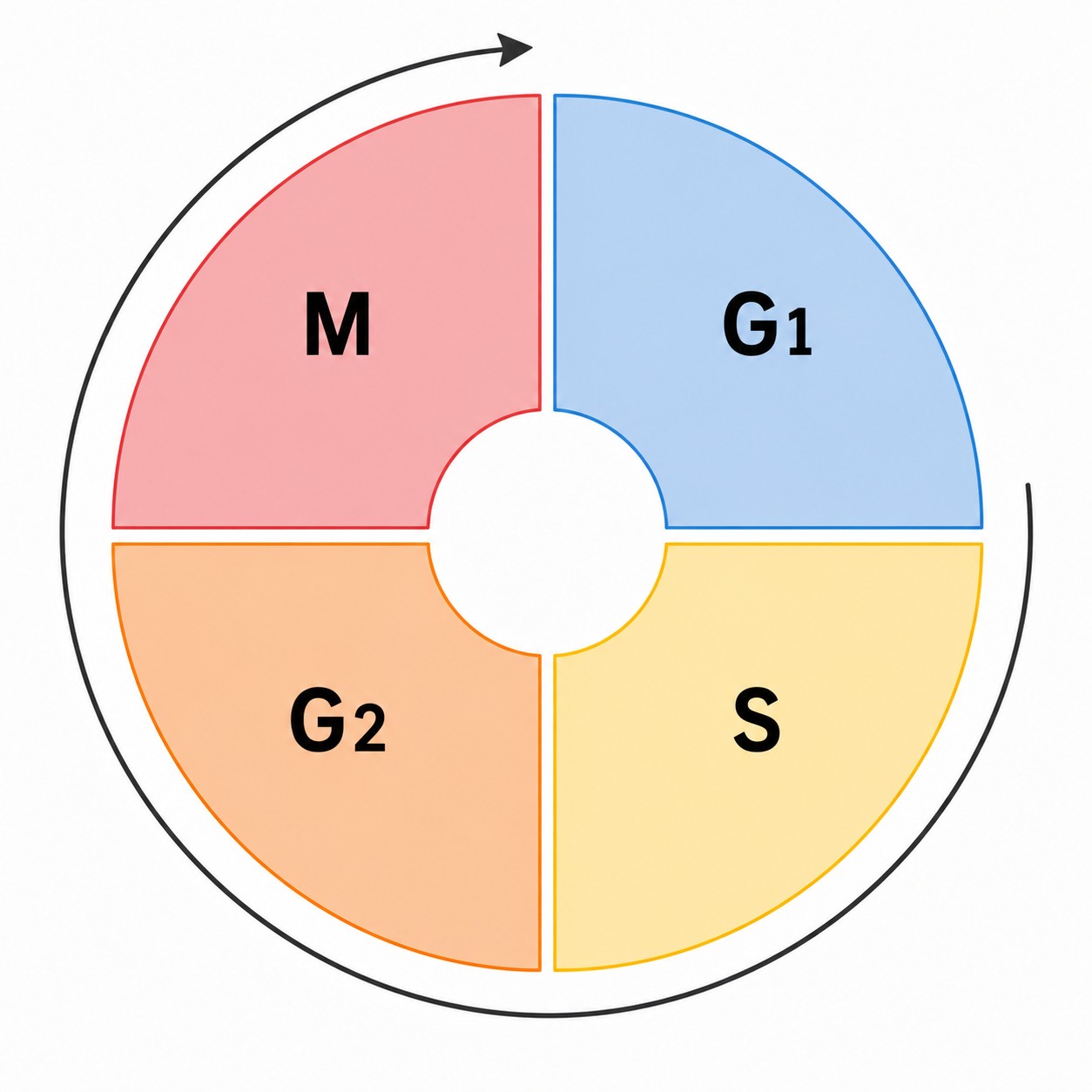
AM phase
BG2 phase
CG1 phase
DS phase
Explanation
📌 DNA replication occurs during S phase (Synthesis) of interphase.
Interphase: G1 → S → G2, then Mitosis.
Interphase: G1 → S → G2, then Mitosis.
Question 20 of 20
The carbon cycle involves:
Aonly living organisms
Bthe movement of carbon through living and non-living systems
Conly the ocean
Donly the atmosphere
Explanation
📌 Carbon moves through: atmosphere (CO₂) → photosynthesis → organisms → respiration/decomposition → atmosphere.
Also: fossil fuels → combustion → atmosphere.
Also: fossil fuels → combustion → atmosphere.